
But running a dedicated digital platform like AERIALIS Kites means keeping a steady hand on the regulatory horizon as well, navigating the AI transparency maze.
With our geographical roots firmly planted in Norway, you might assume EU legislation stays outside our flight path. However, the regulatory landscape is shifting, and for creators who look beyond national borders, the rules of the sky are changing fast.
The New EU Rules: What the AI Act Demands
The European Union has officially activated its landmark Artificial Intelligence Act (specifically focusing on transparency and labeling requirements under Article 50). The core principle is straightforward: if content is fully or partially generated by AI, people have a right to know.
For digital publishers, this regulation introduces clear, mandatory guidelines:
- Synthetic Media & Visuals: Images, videos, and audio generated or heavily modified by AI that depict realistic scenes must be clearly and visibly labeled as artificial.
- Interactive and Text Content: Chatbots must disclose their non-human nature, and text published to inform the public on matters of public interest must carry transparency notices (unless subjected to rigorous human editorial control).
- Technical Traceability: Platforms are expected to support metadata or digital markers to help track the AI-assisted origin of content.
Violating these mandates can lead to heavy regulatory enforcement, with penalties reaching up to millions of euros or a significant percentage of global annual turnover.
Why This Matters for AERIALIS Kites
Even though AERIALIS Kites originates in Norway—which is part of the EEA rather than a direct EU member state—the AI Act carries extraterritorial reach.
Because our articles, media galleries, and project updates reach enthusiasts, festival organizers, and readers across EU member states, these rules apply directly to how we operate online. Ignoring them isn’t an option if we want to maintain an open, trusted line of communication with our international community.
Our Response: Transparency in Action at AERIALIS Kites
We believe that honesty and clarity are just as important in digital publishing as they are on the flying field. That is why we are proactively adapting AERIALIS Kites to meet these new standards head-on.
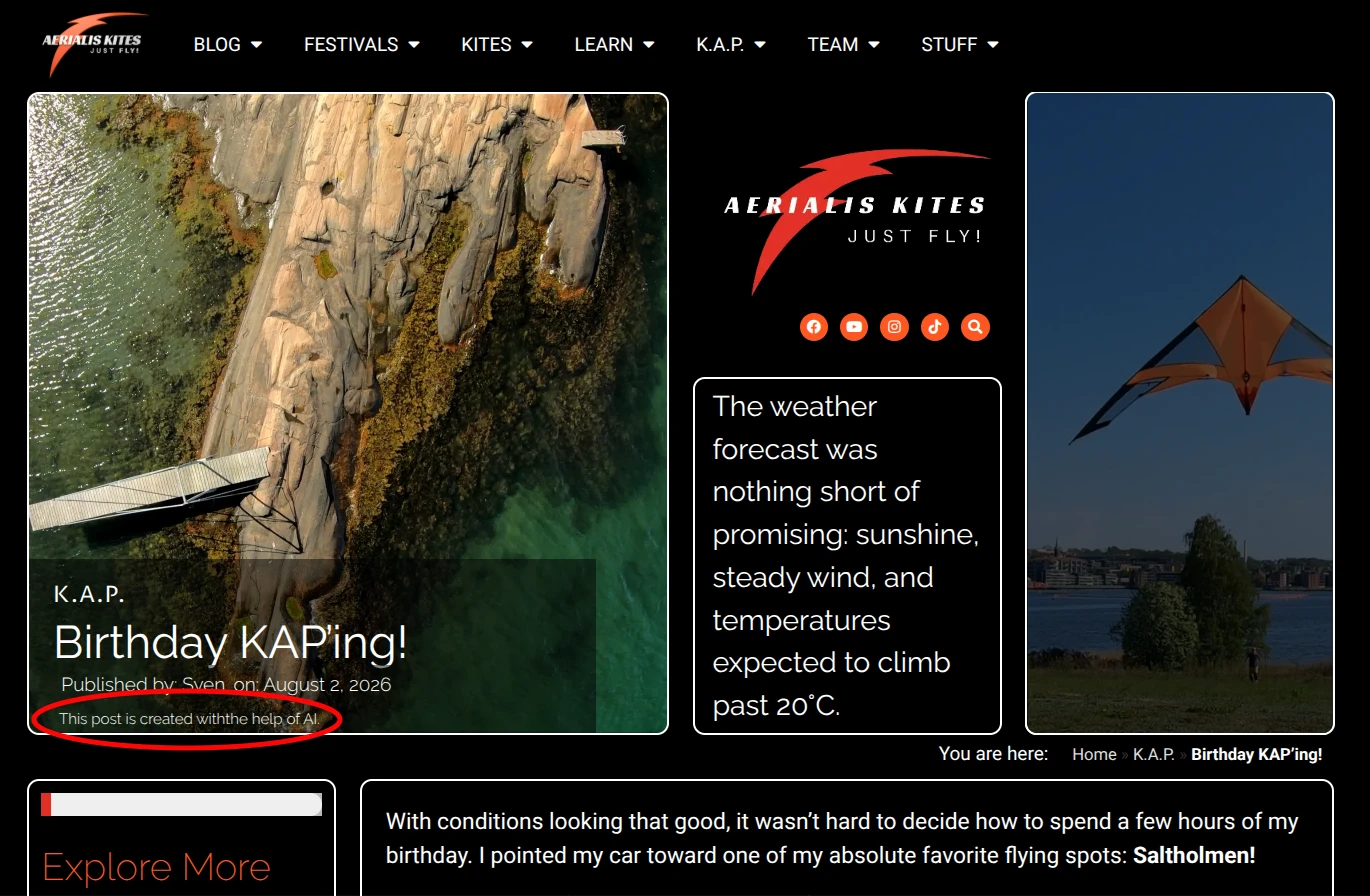
As the editor of the site, I have officially implemented a transparency labeling system across our platform. Moving forward, individual posts, articles, and media features will clearly indicate whether they have been created (fully or partially) with the assistance of AI tools.
- Work in Progress: We have not yet finished labeling every single legacy post across the site’s archives. This is a massive undertaking, but the retroactive labeling process is already in full swing.
- Future-Proof Publishing: Going forward, any new posts crafted with AI assistance will be properly and visibly marked before they hit the publish button.
Clear Skies Ahead
Technology should enhance our passion for exploration, kite aerial photography, and creative storytelling—not cloud it in ambiguity. By embracing these transparency standards, we ensure that AERIALIS Kites remains a reliable, compliant, and open space for enthusiasts across Norway, Europe, and beyond.
Clear skies and happy flying!
Updated August 4th 2026
How Detailed Should We Be About AI?
As we navigate these new transparency requirements, a natural question arises from behind the keyboard: How detailed should I actually be about the varied use of AI when drafting articles here on AERIALIS Kites?
Finding the right balance depends on a mix of what EU regulations (AI Act Article 50) strictly demand of a digital publisher, and what maintains solid, honest credibility with you—our readers, fellow kite flyers, and outdoor creators.
Here is a quick guide to how granular our approach is:
1. The Legal Minimum Requirement (What the Law Demands)
Fortunately, the EU regulations do not require a tedious, exhaustive “AI declaration” detailing the exact prompts used or the precise percentage of text generated. The core mandate boils down to functional transparency:
- For Text Content: The law distinguishes between general creative writing and material published to inform the public on “matters of public interest.” For a niche site focused on kites, wind, photography, and outdoor life, most content falls under hobby, travel, and niche culture where requirements are lighter. However, when we touch upon regulatory updates or technical safety, the bar for care rises.
- The Human Editorial Exemption: If content undergoes thorough human editorial review and the editor takes full editorial responsibility, the strictest labeling requirements for text are eased. Even so, leaning toward open disclosure is always best practice.
- Images and Media: When dealing with synthetic images or video graphics depicting realistic scenes, clear labeling indicating they are artificially generated is strictly required—crucial for distinguishing between real Kite Aerial Photography (KAP) captures and conceptual art.
2. What Makes Practical Sense for AERIALIS Kites
For a specialized platform dedicated to kite building, flight dynamics, and visual expeditions, our disclosure level needs to bridge legal compliance and clean reader trust:
- Keep It Standardized (Moderately Detailed): The most effective path is using a simple, visible label at the top or bottom of relevant posts, such as:“This article was written with AI assistance and edited/approved by the editor.”You won’t find a breakdown of specific language models or technical parameters here unless it’s shared as a fun technical curiosity.
- Distinguishing Text from Visual Data:
- If AI helps structure a draft, refine phrasing, or brainstorm ideas, a general note that AI contributed to the writing process is entirely sufficient.
- If we ever publish pure AI-generated illustrations of kites in extreme hypothetical environments, those specific images will carry distinct markers so they are never mistaken for authentic shots from our field expeditions.
The Verdict for AERIALIS Kites
We are keeping it simple, transparent, and concise. A standardized note stating that a post was developed with the support of artificial intelligence and quality-assured by the editorial desk proves that we take compliance seriously—all without cluttering the reading experience with unnecessary noise.
Clear workflows mean more time focusing on what really matters: the wind, the lines, and the next great flight.